Story · Dynasties
The Rockefellers after Standard Oil
How trusts, foundations and a family office carried an oil fortune onward
A fortune multiplied by a breakup
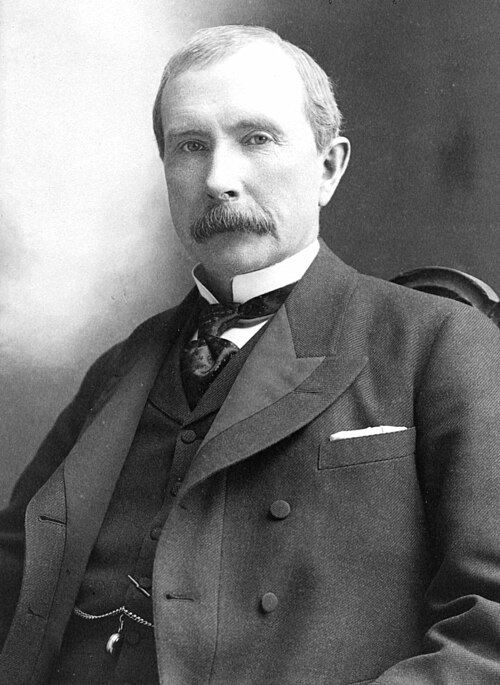
John D. Rockefeller set up an office to manage his own money in 1882, by some accounts the first full-service family office in the United States. His only son, John D. Rockefeller Jr., joined the business in 1897, working from the family office at 26 Broadway, and became a director of Standard Oil. In 1910 Junior resigned from Standard Oil and US Steel to keep his philanthropy apart from business. The next year the Supreme Court broke Standard Oil into 34 companies. Senior, who held more than a quarter of the stock, received shares in all of them, and as their combined value rose fivefold his wealth reached about 900 million dollars.
Sources: John D. Rockefeller · John D. Rockefeller Jr. · Rockefeller Capital Management
The foundation and Ludlow
Junior became the first president of the Rockefeller Foundation, set up by his father, in May 1913. Ownership also brought notoriety. Junior held 40 per cent of the Colorado Fuel and Iron company and sat on its board, and when its miners struck, the dispute led in April 1914 to the Ludlow Massacre, in which at least 20 people died at a strikers' tent camp. Many blamed him, and in 1915 he was called to testify before the Commission on Industrial Relations. Afterwards he became a leading backer of the new field of industrial relations, founding a consulting firm, Industrial Relations Counselors, in 1926.
Sources: John D. Rockefeller Jr.
Rockefeller Center
Junior's biggest business venture was property. In 1928 he leased land in Midtown Manhattan from Columbia University for 87 years at 3 million dollars a year, for a new opera house. After the 1929 crash the Metropolitan Opera pulled out, and Junior persuaded RCA and its affiliates NBC and RKO to anchor a media and office complex instead. The family paid for the construction itself. The first buildings opened in 1933, and the family office moved to the 56th floor of 30 Rockefeller Plaza, known as Room 5600. The complex carried 26 million dollars of debt by 1935, but by 1941 it was nearly full and making a profit.
Sources: Rockefeller Center · John D. Rockefeller Jr. · Rockefeller family
Trusts for the grandchildren
Junior gave away more than 537 million dollars in his lifetime, against about 240 million to his own family, and much of what the family kept was locked up in trusts. The trust of 1934, which holds the bulk of the fortune, runs until the death of the fourth generation; a second followed in 1952. Both were administered by Chase and overseen by a trust committee, holding shares in Standard Oil's successors, other investments and property. In 1940 Junior's five sons set up their own charity, the Rockefeller Brothers Fund, which received a 58 million dollar endowment from their father in 1951.
Sources: Rockefeller family · John D. Rockefeller Jr. · Rockefeller Brothers Fund
Five brothers, one banker
The five brothers divided the family's public roles. Nelson and Winthrop became state governors, and Nelson was later Vice President. Laurance became a venture capitalist and conservationist, and John III a philanthropist. The youngest, David, chose banking. He joined Chase National Bank in 1946, when his uncle was chairman, became president of what was by then Chase Manhattan in 1960, and was its chairman and chief executive from 1969 to 1980. In 1980 he was also the bank's largest individual shareholder, with 1.7 per cent. His record was mixed: Chase was labelled a problem bank by the Federal Reserve in 1975, then recovered.
Sources: David Rockefeller · John D. Rockefeller Jr.
Selling the Center
The family's grip on its most famous asset slipped in the late 1980s. Columbia still owned the land under Rockefeller Center until 1985, when it sold it to the family's company, the Rockefeller Group, for 400 million dollars. In 1989 Mitsubishi Estate, part of the Mitsubishi group, bought the Rockefeller Group. Six years later, in May 1995, it filed for bankruptcy protection after missing mortgage payments. That November, David Rockefeller and a consortium led by Goldman Sachs agreed to buy the buildings for 1.1 billion dollars. Since 2000 the complex has been controlled by Tishman Speyer, which paid 1.85 billion dollars.
Sources: Rockefeller Center
From family office to wealth firm
The office Senior started kept evolving. In 1979 the family set up Rockefeller and Co., a money manager that also took outside clients, alongside the venture investor Venrock, an early backer of Apple. In 2014 the Rockefeller Brothers Fund said it would sell its fossil fuel investments. David, the family's patriarch, died in 2017 aged 101. That October, Viking Global Investors agreed to take a majority stake in the family's money manager, which relaunched in 2018 as Rockefeller Capital Management under an outside chief executive. At the end of September 2025 it reported 187 billion dollars of client assets.
Sources: Rockefeller Capital Management · Rockefeller family · Rockefeller Brothers Fund · David Rockefeller · www.rockco.com