Story · Company histories
Ford's five-dollar day and what came after
A famous pay rise, its strings, and Ford's long fight with organised labour
The price of the moving line
Ford's moving assembly line, refined through 1913, cut the time to build a Model T from about 12 and a half hours to 93 minutes. It did so by breaking skilled craftwork into simple, repeated tasks, and the men doing them were bored. Lateness and absenteeism rose and many simply walked out. Some departments had to hire 300 men a year to keep 100 places filled, and The Henry Ford museum puts annual labour turnover at 370 per cent. The line only worked with a steady crew, and training every new hand was expensive.
Sources: fords-five-dollar-day · Henry Ford
5 January 1914
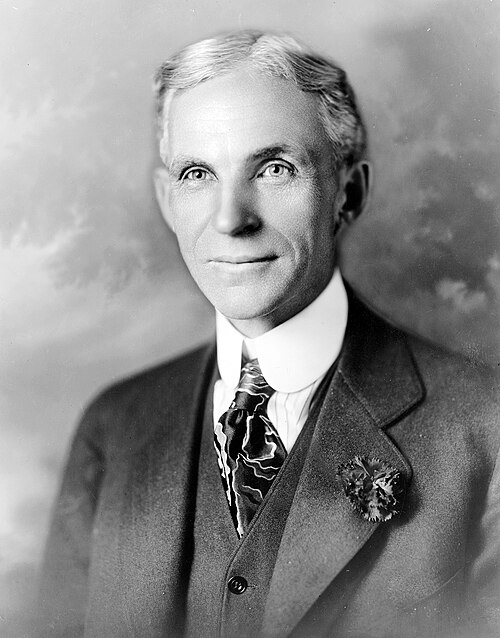
On 5 January 1914 Henry Ford and his vice president James Couzens announced that the minimum daily pay for qualifying men would rise from 2.34 dollars to 5 dollars, more than double what most of the workforce earned. Couzens, who had run the business side of the company since its early days, may have been the one who persuaded Ford to do it. Newspapers around the world ran the story. A Cleveland paper likened it to a blinding rocket lighting up a depressed industrial scene. Ford himself described the increase as a form of profit sharing, a reward for the productive and the well behaved.
Sources: Henry Ford · James Couzens · fords-five-dollar-day
Crowds at the gate
The offer worked almost too well. Within days thousands of job seekers from across the Midwest had arrived in Detroit and camped outside the Ford plant's gates. The company could not cope, riots broke out, and the crowds were driven back with fire hoses in the January cold. Ford then said it would hire only men who had lived in Detroit for at least six months, and the situation gradually calmed. The scene showed what economists would later stress: by paying far above the going rate, Ford was no longer struggling to find workers but rationing jobs among a queue of applicants, and it could choose whom it kept.
Sources: fords-five-dollar-day · Efficiency wage
A bonus, not a raise
The headline figure hid the structure. A worker's base wage did not change: a man on about 2.30 dollars a day still earned that, and the rest, about 2.70 dollars, was a profit-sharing bonus paid only to those who met the company's conditions. To qualify, a man had to have worked at Ford for six months and to live in a way the company approved of. The offer applied to qualifying male workers. Henry Ford's reasoning was that workers distracted by money troubles or bad habits at home would work badly, so the extra money came with the right to check how it was spent.
Sources: fords-five-dollar-day · Henry Ford
The Sociological Department
Checking fell to Ford's Sociological Department, run from 1913 to 1921 by the Episcopal minister Samuel Marquis, with some 50 investigators and support staff. Inspectors visited workers' homes, asked probing questions and looked at living conditions. To get the bonus a worker had to stay off drink, not abuse his family, not take in lodgers, keep a clean home and save regularly. Families found in breach were given advice and pointed to company help, and the full bonus was held back until they complied. Workers resented the intrusion. By 1921 the department was largely gone, and in his 1922 memoir Ford wrote that paternalism had no place in industry.
Sources: fords-five-dollar-day · Henry Ford
Why it paid
The higher wage turned out to be good business. The best mechanics in Detroit came to Ford, bringing skills that raised productivity and cut training costs. Competitors and parts suppliers had to raise pay too or lose their best people, and car industry wages ended up about 40 per cent above the rest of manufacturing. In a 1987 study the economists Raff and Summers concluded that the five-dollar day fits the theory of efficiency wages: paying above the market rate to cut turnover, lift morale and raise output. Ford also liked to point out that better-paid workers could afford his cars. In 1926 Ford cut the factory week to five eight-hour days.
Sources: Henry Ford · Efficiency wage · fords-five-dollar-day
The Hunger March
The Depression reversed the story. American vehicle output fell from 5.3 million in 1929 to 1.3 million in 1931, and the average auto worker's annual pay fell by 54 per cent. By 1932, 400,000 people were out of work in Michigan. Ford, who called unions the worst thing that ever struck the earth, had put a former navy boxer, Harry Bennett, in charge of a Service Department to keep them out. On 7 March 1932 at least 3,000 unemployed workers marched to the River Rouge plant in Dearborn with a list of demands. Dearborn police and Ford security guards opened fire, and five marchers died.
Sources: Ford Hunger March · Henry Ford
From the overpass to a union shop
The United Auto Workers, founded in 1935, organised Ford's rivals but not Ford, whose Service Department grew to some 3,000 men and watched workers inside and outside the plants. On 26 May 1937, as UAW organisers including Walter Reuther prepared to hand out leaflets on an overpass at the Rouge, Bennett's men beat them. Photographs of the injured, published nationally, turned opinion towards the union. Ford was the last Detroit carmaker to give in. A sit-down strike closed the Rouge in April 1941, and in June Ford signed a contract with the most favourable terms in the industry, including a union shop. Paternalism had given way to collective bargaining.
Sources: Battle of the Overpass · Henry Ford