Story · Company histories
From Model T to Toyota: mass production to lean production
Detroit builds cars by the million; Toyota learns to build them with less
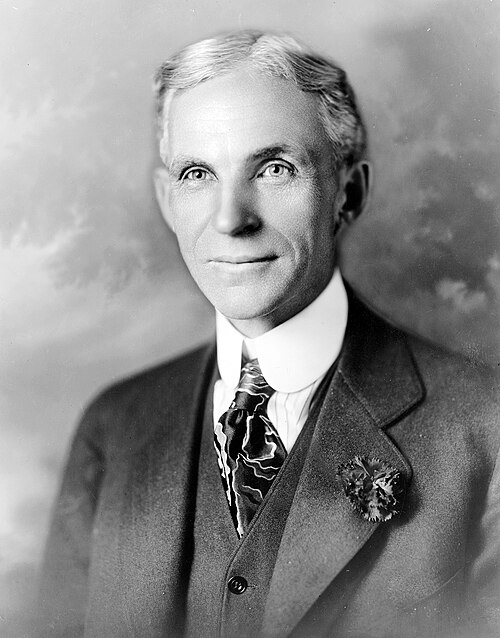
Ford and the Model T
Henry Ford's company was incorporated on 16 June 1903, starting in a converted factory with 28,000 dollars in cash from twelve investors, among them John and Horace Dodge. It worked through a run of models named by letters, A, B, C, F, K, N, R and S, before the Model T went into production on 1 October 1908. The savings from mass production were passed on to buyers: the price fell from 780 dollars in 1910 to 290 dollars in 1924. By the time the last one was built in 1927, about fifteen million had been made.
Sources: Ford Motor Company · Ford Model T
The moving line at Highland Park
Ford's Highland Park plant, designed by Albert Kahn's firm, opened in 1910. On 7 October 1913 it became the first car factory in the world to use a moving assembly line. Part of the idea came from Chicago's meatpackers: William Klann had watched carcasses travel past butchers on a conveyor at Swift and Company and brought the principle back to Ford. Instead of workers carrying parts to a car standing still, the car moved from station to station, and each worker did one simple job. The time to assemble a Model T fell from 728 minutes to 93.
Sources: Highland Park Ford Plant · Assembly line
The five-dollar day
The line needed a steady workforce, and Ford could not keep one: some departments hired 300 men a year to fill 100 places. On 5 January 1914 the company announced that factory pay would rise from 2.34 dollars a day to 5 dollars, more than double what most of its workers earned, while shifts were cut from nine hours to eight. The best mechanics in Detroit came to Ford, and the company claimed turnover fell from 31.9 per cent in 1913 to 1.4 per cent in 1915. There were strings attached: the full rate depended on living in a way Ford's Social Department approved.
Sources: Highland Park Ford Plant · Henry Ford
The Rouge: owning every step
Ford then set out to control the whole chain from raw material to finished car. The River Rouge complex in Dearborn, Michigan, built between 1917 and 1928, had its own docks on the dredged river, about 100 miles of internal railway, its own power station and an integrated steel mill, so raw materials went in and running vehicles came out of a single site. It is a textbook case of vertical integration. After the Model T ended in May 1927, the Rouge, which had made tractors since 1921, closed for five months and reopened to build its successor, the Model A.
Sources: Ford River Rouge complex · Ford Model T
Looms first, then cars
Toyota began as a loom maker. Sakichi Toyoda invented the Model G automatic loom in 1924, and his looms stopped themselves the moment a thread broke or ran out, an idea Toyota would later call jidoka. In 1929 the loom patent was sold to Platt Brothers in Britain, raising the money to develop cars. Sakichi's son Kiichiro set up an automobile division inside Toyoda Automatic Loom Works on 1 September 1933, and on 28 August 1937 it began trading separately as Toyota Motor Company. The Japanese government helped by stopping Ford and General Motors from importing cars into Japan.
Sources: Toyota · Kiichiro Toyoda · Autonomation
Too small to copy Ford
Toyota came out of the war in trouble. With sales and profits falling, it announced 1,600 voluntary retirements, and in June 1950 Kiichiro resigned as president to take responsibility. That year a group of executives including his cousin Eiji Toyoda went to the United States, trained at Ford and studied dozens of American plants. Eiji toured the River Rouge and was struck by its scale but unimpressed by its waste. The gap was enormous: Toyota had built just over 2,500 cars in thirteen years, while the Rouge turned out 8,000 vehicles a day. Eiji resolved to take up American mass production, but with a twist of Toyota's own.
Sources: Kiichiro Toyoda · Toyota · Eiji Toyoda
The Toyota Production System
Between 1948 and 1975 Eiji Toyoda and Taiichi Ohno, an engineer who had joined the family's spinning business in 1932 and moved to the car company in 1943, built the Toyota Production System. Two ideas sat at its centre. Just-in-time meant making only what is needed, when it is needed, in the amount needed. Jidoka meant that a machine, or a worker, stops the line as soon as something goes wrong. Ohno took inspiration from American supermarkets, which restock shelves only as customers take goods, and used kanban cards to signal when parts were needed. The target was waste, above all overproduction.
Sources: Toyota Production System · Taiichi Ohno · Kanban · Autonomation
NUMMI: lean comes to America
In 1984 Toyota and General Motors reopened GM's old plant in Fremont, California, as a joint venture called New United Motor Manufacturing, or NUMMI. GM had shut it in 1982. A union leader later called its workforce the worst in the American car industry, and its lines seldom stopped, so mistakes were left to be fixed later. GM wanted good small cars and a close look at the Toyota system; Toyota got its first manufacturing base in North America. Toyota's methods went on to inspire what became known as lean manufacturing, and in the first quarter of 2008 Toyota led the world in car sales.
Sources: NUMMI · Toyota Production System · Toyota