Story · Company histories
Standard Oil and the age of trusts
Rebates, trusts, a billion-dollar steel merger and the law that broke them up
A refinery in the Flats
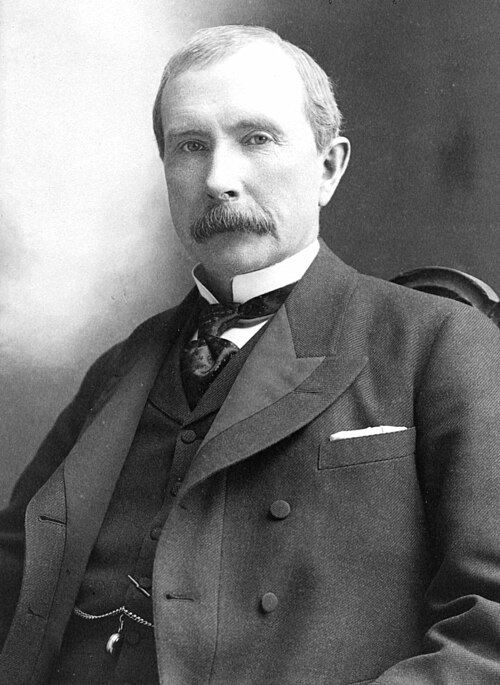
John D. Rockefeller started out in the produce trade in Cleveland, and as the Civil War neared its end he and his partners looked to oil. Kerosene for lamps was in demand, and a refinery cost only about 1,000 to 1,500 dollars to build. In 1863 they put one up in the Flats, Cleveland's industrial district, with the chemist Samuel Andrews. In 1865 Rockefeller bought out the Clark brothers at auction for 72,500 dollars, and in 1867 Henry Flagler joined as a partner. Where rivals dumped waste, Rockefeller burned gasoline as fuel and sold by-products such as lubricating oil and paraffin wax.
Sources: John D. Rockefeller
Standard Oil and the rebate
In 1870 Rockefeller replaced the partnership with a corporation, the Standard Oil Company of Ohio, with 1 million dollars of capital. He held the largest block of shares, while Flagler, his brother William and Samuel Andrews held smaller ones. Flagler championed rebates, secret discounts from railways in return for guaranteed volume. In one 1868 deal the Lake Shore Railroad gave the firm an effective 71 per cent discount on its listed rate for a promise of at least 60 carloads a day. Small refiners could never ship enough to qualify. Kerosene fell from 58 to 26 cents between 1865 and 1870.
Sources: Standard Oil · Henry Flagler
The Cleveland Massacre
In late 1871 the president of the Pennsylvania Railroad set up the South Improvement Company, a secret pact between railways and a few big refiners, Rockefeller among them. Members would get rebates on their own oil, payments on every barrel their competitors shipped and reports on rivals' shipments. With that threat hanging over them, Cleveland refiners sold out: between mid-February and mid-March 1872 Rockefeller and Flagler bought 23 companies, all but one in Cleveland. Historians call it the Cleveland Massacre. When the scheme leaked, independent producers protested and Pennsylvania suspended the charter in April 1872. No oil was ever shipped under it.
Sources: South Improvement Company · Standard Oil
The trust
State laws made it hard for one company to own businesses in other states, so on 2 January 1882 Rockefeller and his associates found a way round them. The shareholders of the Standard companies handed their stock, in trust, to nine trustees, among them John and William Rockefeller and Henry Flagler, who then ran the whole group as one. The trust was valued at 70 million dollars. The structure worked so well that other giant enterprises copied it. In 1885 the headquarters moved from Cleveland to New York, and by 1890 Standard controlled 88 per cent of the refined oil flowing in the United States.
Sources: Standard Oil
The Sherman Act
In 1890 Congress passed the Sherman Antitrust Act, named after its principal author, Senator John Sherman of Ohio, by 51 votes to 1 in the Senate and 242 to 0 in the House. It banned contracts and conspiracies in restraint of trade and attempts to monopolise, and let the Justice Department sue. Ohio moved against Standard first, and its Supreme Court dissolved the Standard Oil Trust in 1892. The group simply regrouped. New Jersey changed its laws to let a company hold shares in companies in any state, and in 1899 Standard Oil of New Jersey became the holding company for the whole group.
Sources: Sherman Antitrust Act · Standard Oil
The billion-dollar corporation
Steel got its own giant in 1901. Andrew Carnegie, aged 65 and thinking of retirement, agreed to sell Carnegie Steel to the banker J. P. Morgan, who wanted to merge the big producers into one integrated company and cut out duplication. Morgan combined Carnegie Steel with Federal Steel and National Steel to create the United States Steel Corporation, capitalised at 1.4 billion dollars, which made it the world's first billion-dollar corporation. Carnegie's own share, about 226 million dollars, was paid in gold bonds. In 1902, its first full year, U.S. Steel made 67 per cent of all the steel produced in the United States.
Sources: U.S. Steel · Andrew Carnegie
Ida Tarbell's exposé
Ida Tarbell's father was an oil producer whose business had failed because of Rockefeller's dealings. Writing for McClure's magazine, she interviewed Henry H. Rogers, a senior Standard Oil executive, and others close to the company, and found evidence that it was rigging railway rates and preying on competitors. Her series ran in 19 parts from November 1902 to October 1904 and came out as a book, The History of the Standard Oil Company, in 1904. It became a landmark of muckraking journalism. By then Standard controlled 91 per cent of oil refining in the United States, and the public outcry hastened action against it.
Sources: Standard Oil · The History of the Standard Oil Company
Broken up
In November 1906 the Justice Department sued Standard Oil of New Jersey under the Sherman Act, and in 1911 the Supreme Court agreed that it had illegally monopolised the oil industry and ordered it to break itself up into more than thirty companies. The court also held that the law banned only unreasonable restraints of trade, the rule of reason. The break-up did not hurt Rockefeller: his shares rose in value as the new companies traded. Jersey Standard later became Exxon and then ExxonMobil, Standard Oil of California became Chevron, and BP eventually absorbed the Ohio and Indiana companies.
Sources: Standard Oil Co. of New Jersey v. United States · Standard Oil · The History of the Standard Oil Company