Story · People
Henry Ford: three companies and a buyout
Two failed car firms, then Ford Motor, a court fight and total family control
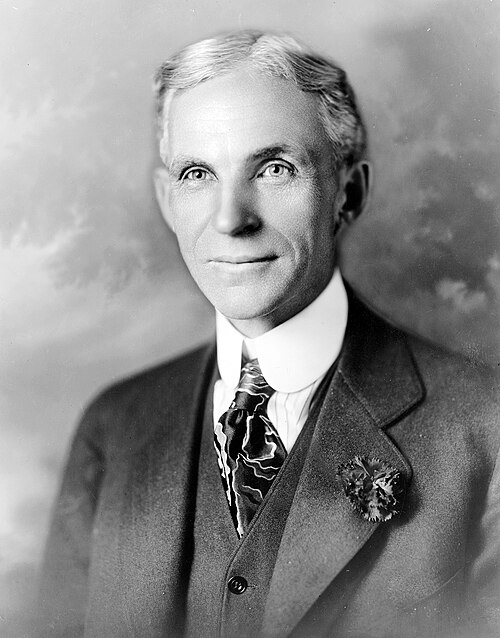
An engineer at Edison's company
Henry Ford grew up on a farm in Greenfield Township, Michigan, and left for Detroit at 16. By the late 1880s he was repairing and building engines, and in 1891 he became an engineer at the Edison Illuminating Company of Detroit. Promotion to chief engineer in 1893 gave him the money and spare time to experiment with petrol engines. In 1896 he finished his first self-propelled vehicle, the Quadricycle, and test-drove it on 4 June. That year he met Thomas Edison at a meeting of the company's executives, and Edison encouraged his experiments. A second car followed in 1898.
Sources: Henry Ford
Two false starts
Backed by the Detroit lumber baron William H. Murphy, Ford left Edison and founded the Detroit Automobile Company on 5 August 1899. Its cars came out dearer and of lower quality than he wanted, and the company was dissolved in January 1901. Ford turned to racing to prove himself. In October 1901 he won a race in a 26-horsepower car built with C. Harold Wills, and Murphy's group backed him again, forming the Henry Ford Company on 30 November 1901 with Ford as chief engineer. When Murphy brought in the engineer Henry Leland as a consultant in 1902, Ford walked out, and Leland renamed the firm the Cadillac Automobile Company.
Sources: Henry Ford
Third time, with partners
Ford's next backer was Alexander Malcomson, a Detroit coal dealer. Their partnership leased a factory and ordered more than 160,000 dollars of parts from the machine shop of John and Horace Dodge, but sales were slow and the Dodges demanded payment. Malcomson's answer was to bring in more investors and persuade the Dodges to take shares instead. On 16 June 1903 the partnership was reincorporated as the Ford Motor Company, with 28,000 dollars of capital. Ford was not trusted to run it: because of his volatility, Malcomson's uncle, John S. Gray, was elected president. Ford built the brand the way he knew, setting a speed record on frozen Lake St. Clair.
Sources: Henry Ford
Dodge v. Ford
The Model T, told in other stories, made the company enormously profitable, and by 1916 it had a surplus of 60 million dollars. Ford, by then the majority shareholder, wanted to end special dividends and pour the money into new plants, more jobs and lower prices, and he said openly that returns to his fellow shareholders were not his main concern. John and Horace Dodge, who owned 10 per cent, sued. Ford suspected, correctly, that their dividends were funding a rival car company. In 1919 the Michigan Supreme Court ordered an extra dividend of 19.3 million dollars, holding that a business exists mainly to profit its shareholders. The case is still taught today.
Sources: Dodge v. Ford Motor Co.
Tractors on the side
Ford was also looking beyond cars. He had built an experimental tractor in 1907, and in 1916 a separate company, Henry Ford & Son, completed prototypes of a small, cheap, mass-produced tractor. The war supplied the first big customer. In 1917 Britain's Ministry of Munitions, desperate to grow more food while ships were being sunk, chose the design, and thousands were shipped from the United States in 1917 and 1918. Sold as the Fordson, it did for farm machinery roughly what the Model T did for cars. Ford dominated the tractor market from about 1917 to 1925, and 552,799 Fordsons were built between 1917 and 1928, some of them at a plant in Cork, Ireland.
Sources: Fordson
Buying out the partners
The dispute pushed Ford to get rid of his minority shareholders altogether. In December 1918 he handed the presidency of Ford Motor to his son Edsel, while keeping the final say. He then threatened to set up a competing car maker, and made a show of moving himself and his best staff to Henry Ford and Son, a signal that the old company's shares might soon lose most of their value. The holdouts sold. Henry and Edsel bought every remaining share, and the Ford family became the sole owners of the company. The Dodges, meanwhile, used the money from the case to expand their own firm, Dodge Brothers.
Sources: Henry Ford · Dodge v. Ford Motor Co.
Lincoln, and the costs of control
Sole control let Ford buy what he wanted. In 1922 he bought the Lincoln Motor Company, a luxury car maker founded during the war by Henry Leland, the man whose arrival had pushed Ford out of his second company, and Leland's son. The Lelands stayed briefly and were then expelled. Henry had little interest in luxury cars; it was Edsel who wanted Ford to move upmarket. Total control had costs too. Sales of the ageing Model T flagged until Ford accepted a new car, the Model A, in late 1927. In the same decade his newspaper, the Dearborn Independent, published antisemitic conspiracy articles, until a libel suit led him to close it in 1927.
Sources: Henry Ford · Ford Motor Company
Willow Run and the handover
Answering President Roosevelt's call for an arsenal of democracy, Ford had his company build a vast aircraft plant at Willow Run, near Detroit, from spring 1941. It was then the largest assembly line in the world, and at its 1944 peak it built 650 B-24 bombers a month, 9,000 in all. The company itself was in poor shape. Ford, weakened by strokes, took back the presidency when Edsel died in 1943, and it was soon losing more than 10 million dollars a month. In September 1945 his wife Clara and Edsel's widow Eleanor, threatening to sell their shares, forced him to hand control to his grandson Henry Ford II. He died in 1947.
Sources: Henry Ford