Story · Regions
How business began in Egypt
Fustat merchants, cotton monopolies, Banque Misr, nationalisation, Orascom
A merchant prince in Fustat
Some of the oldest business letters in the world were found in Old Cairo. The Cairo Geniza, a storeroom in the Ben Ezra synagogue at Fustat, held about 400,000 fragments, including merchants' account books and correspondence. Among them are 61 letters sent from the 980s to 1078 to Yusuf ibn 'Awkal and his family, a Jewish trading house that had moved to Fustat after the Fatimid conquest of 969. Ibn 'Awkal rarely left home. He shipped goods across the western Mediterranean to partners who sold them, sent agents into the countryside to buy flax at harvest, and kept an office in Cairo's gem market to sell jewels to the court.
Sources: Cairo Geniza · Yusuf ibn 'Awkal · Fustat
Muhammad Ali's state monopoly
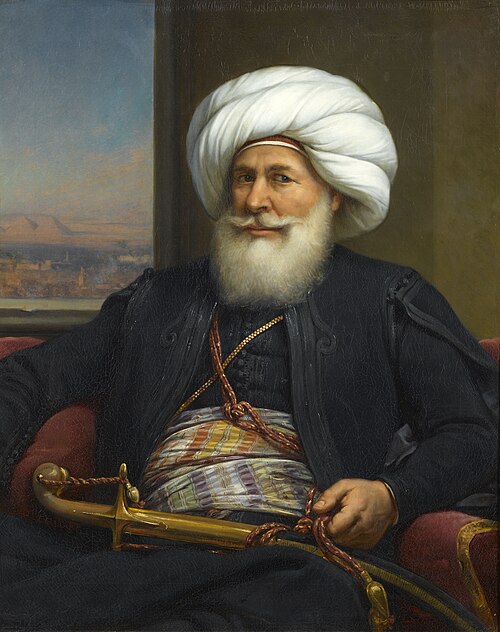
Muhammad Ali, who ruled Egypt for the Ottomans from 1805, turned its trade into a state monopoly. He took over the lands of the old tax farmers and required every producer to sell to the state, which resold the goods at home and abroad and kept the margin. Long-staple cotton, developed in Cairo in the 1820s, became the great cash crop. He also built factories: arms works in Cairo, a naval shipyard in Alexandria, and by the 1830s about 30 cotton mills with 30,000 workers. The mills failed through poor management, fuel shortages and forced labour, and an 1838 treaty with Britain forced an end to his monopolies.
Sources: Muhammad Ali of Egypt · Economy of Egypt · Misr Spinning and Weaving Company
Cotton, debt and dual control
The American Civil War set off a cotton boom in Egypt. Khedive Isma'il, who ruled from 1863, borrowed heavily in Europe for railways from Cairo to Alexandria, Suez and Aswan, for irrigation and for sugar estates and refineries. In about eleven years Egypt ran up some 68 million pounds of debt, plus 20 million more of floating debt. In 1875 he sold Egypt's Suez Canal shares for about 4 million pounds, bought with Rothschild money on the orders of Benjamin Disraeli. It was not enough. On 2 May 1876, after defaulting, he set up the Caisse de la Dette Publique, through which Britain and France supervised Egypt's finances. British troops occupied the country in 1882.
Sources: Caisse de la Dette Publique · Economy of Egypt
Banque Misr, a bank for Egyptians
In 1920 all of Egypt's banks were foreign-owned, including the British-owned National Bank of Egypt. That year the economist Talaat Harb and the industrialist Joseph Cattaui founded Banque Misr with 80,000 Egyptian pounds of capital. It did business in Arabic, was staffed by Egyptians and allowed only Egyptian citizens to own its shares. Harb used it to channel national savings into industry. Its flagship was the Misr Spinning and Weaving Company, founded in 1927 at El Mahalla El Kubra in the Nile Delta, now Egypt's largest industrial site. Harb also founded an airline in 1932, today's EgyptAir, and Studio Misr, which led Egyptian film for three decades.
Sources: Banque Misr · Economy of Egypt · Misr Spinning and Weaving Company
Nasser takes over
In July 1952 army officers led by Gamal Abdel Nasser overthrew the monarchy, and land reform that year set out to weaken the big landowners. Nasser nationalised the Suez Canal Company, and between 1957 and 1961 the state took over key industries and built a large public sector, with the Helwan steelworks and the Aswan High Dam as showpieces. Banque Misr was nationalised in 1960. In 1961 the government also took over a road and waterways contractor that a young engineer, Onsi Sawiris, had founded in 1952; renamed El Nasr Civil Works, it kept him on as its manager for five years. Growth was strong at first, but by the mid-1960s the economy was in crisis.
Sources: Economy of Egypt · Banque Misr · Onsi Sawiris
Opening the door
After the 1973 war, Anwar Sadat reversed course. His Infitah, or open door, written into Law 43 of 1974, invited private and foreign investment, ended the public sector's dominance of the economy and went with a turn from the Soviet Union to the United States. Foreign capital came back too: in 1975 the National Bank of Egypt and Chase Manhattan set up a joint venture that became Commercial International Bank. In 1976 Onsi Sawiris came home from Libya and founded Orascom as a contracting and trading company. In the 1980s and 1990s it spread into tourism, computing and mobile phone networks, and his three sons, Naguib, Samih and Nassef, took over its businesses.
Sources: Infitah · Commercial International Bank · Onsi Sawiris
Privatisation and the Sawiris brothers
In 1991 Hosni Mubarak's government signed a structural adjustment programme with the IMF and World Bank to free trade and shrink the state, and by 2005 it had sold 209 of its 314 public companies, at a cost in jobs and wages. The Sawiris family's businesses flourished in the new private economy. In the late 1990s Orascom was split into separate companies, including Orascom Telecom, set up in 1997 under Naguib Sawiris, and Orascom Construction Industries. Orascom Telecom bought a majority of the Algerian mobile network Djezzy, which became its most profitable unit. By 2003 the family's companies were the three largest stocks by market value on the Cairo exchange.
Sources: Economy of Egypt · Naguib Sawiris · Onsi Sawiris
Floats, Gulf money and the big banks
Egypt is now Africa's second largest economy, but its currency has repeatedly given way. It floated the pound in 2016 with a 12 billion dollar IMF loan, and again in 2024, when the pound lost nearly 40 percent of its value and interest rates rose by a record six percentage points. Gulf capital helped pull it through: in 2024 the UAE agreed a 35 billion dollar deal to develop Ras El Hekma, the largest foreign investment in the country's history. Its big five banks include Banque Misr, nationalised in 1960, and Commercial International Bank, one of the largest in the private sector, in which the Abu Dhabi fund ADQ bought a stake worth about 911 million dollars in 2022.
Sources: Economy of Egypt · Banque Misr · Commercial International Bank